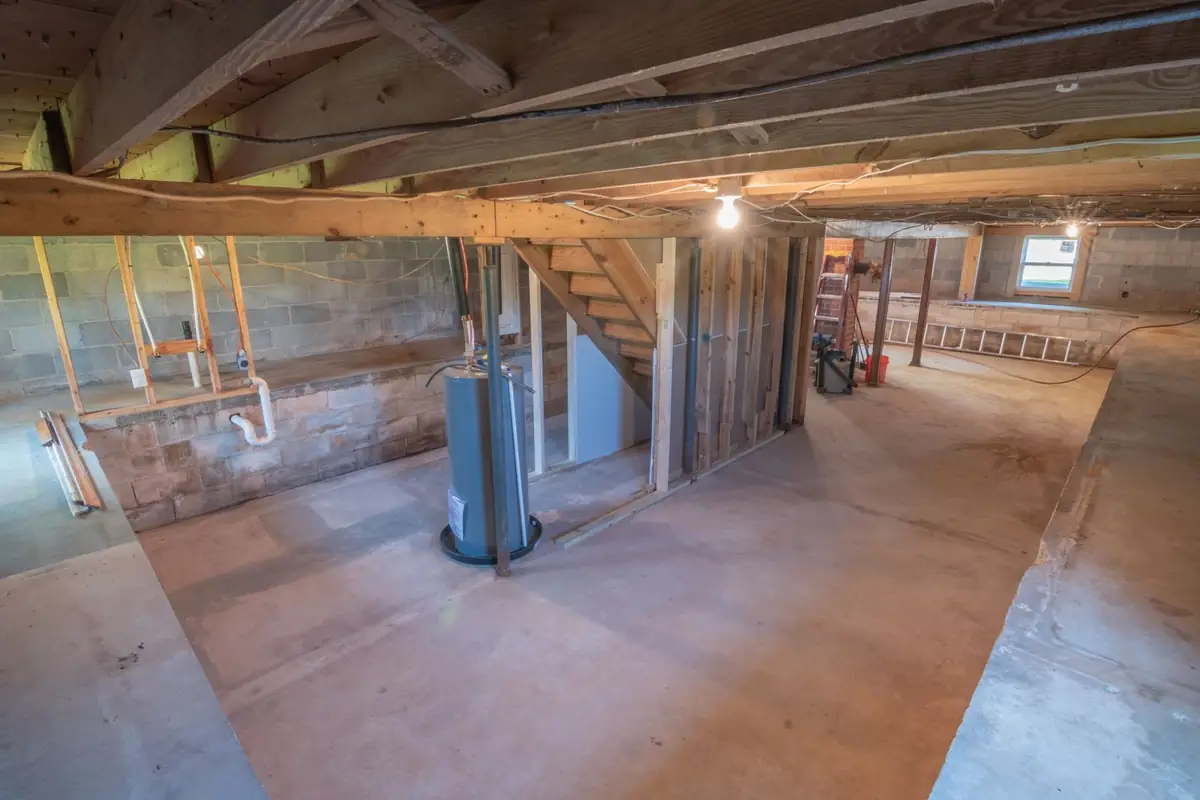
Not every home in the Mahoning Valley has a full basement. Many additions, enclosed porches, and some older homes and ranches sit partly or entirely over a crawl space. Crawl spaces are easy to ignore because few people go into them, but the air down there moves up into the living space. A damp crawl space can mean musty odors, cold floors, wood rot, insects and higher humidity throughout the house.
What encapsulation means
Crawl space encapsulation is the process of sealing the crawl space from outside moisture and treating it more like a conditioned part of the home. A full encapsulation commonly includes:
- A heavy vapor barrier covering the ground and extending up the walls, with seams overlapped and taped, and the edges fastened and sealed to the foundation.
- Sealing vents and openings to the outside so humid summer air is not drawn into a cool space where it condenses.
- Air sealing around rim joists, plumbing and wiring penetrations.
- Moisture control, usually a dehumidifier sized for the space, or in some designs a small supply of conditioned air from the home's HVAC system.
- Drainage where needed, such as a perimeter drain and sump if water pools on the ground.
- Insulation on the foundation walls in some designs, rather than between floor joists.
A simpler step, laying plastic sheeting on the ground, is a vapor retarder only. It helps, but leaves walls, vents and air leaks unaddressed.
Why crawl spaces get damp
Bare soil releases moisture constantly, and in the clay-heavy ground common across the valley, the soil often stays wet into late spring. Vents that were once standard practice let in warm, humid summer air. When that air hits cool soil, foundation walls and ductwork, it condenses. Plumbing leaks, poor grading and downspouts that dump next to the foundation make it worse.
Signs a crawl space needs attention
- Musty or earthy odors in rooms above the crawl space.
- Visible mold or mildew on joists, subfloor or insulation.
- Insulation sagging or falling from between joists.
- Standing water or mud after rain.
- Condensation on ducts or pipes in summer.
- Cupping hardwood floors or cold floors in winter.
- Insects, rodents or signs of wood damage.
The encapsulation process
- Inspection. A specialist checks for standing water, wood damage, mold, vent locations, plumbing and the condition of existing insulation.
- Preparation. Debris, old plastic and damaged insulation are removed. Any wood damage or mold is addressed first, sometimes by a separate contractor.
- Drainage. If water pools, a drain and sump may be installed before the liner.
- Liner installation. The vapor barrier is rolled out, seams are sealed, and the liner is fastened to walls and piers.
- Sealing. Vents and access doors are sealed or replaced with insulated covers, and rim joists are air sealed.
- Humidity control. A dehumidifier with a drain line is installed, and humidity is checked after the system runs.
Combustion appliances and safety
If a furnace or water heater in or near the crawl space draws combustion air from that space, sealing it can change how those appliances vent. That needs to be evaluated before vents are closed. Radon is another consideration. The U.S. EPA and the Ohio Department of Health recommend testing homes for radon, and encapsulation can be coordinated with radon mitigation when needed.
Maintenance after encapsulation
- Check the dehumidifier and its drain line a few times a year.
- Keep the liner intact. Avoid dragging stored items across it.
- Look for new water after heavy rain or snowmelt.
- Keep gutters and downspouts working, since outside water still matters.
Questions to ask
- What thickness and type of vapor barrier is proposed?
- Will the walls be covered, and how will the liner be fastened and sealed?
- How will vents and the access door be handled?
- What dehumidifier is recommended, and where will it drain?
- Is drainage needed before the liner goes in?
- Are combustion appliances or radon a concern in this space?
Cost factors
Cost depends on the square footage and height of the crawl space, how hard it is to work in, the liner thickness, whether walls are covered, the amount of debris and old insulation to remove, drainage needs, dehumidifier choice, and any wood or mold repair. See the cost factors guide for more.
Crawl spaces in Mahoning Valley homes
Crawl spaces in the valley tend to show up in a few common situations: room additions built over a shallow foundation next to a full basement, enclosed porches and sunrooms, some mid-century ranch homes, and older houses where part of the footprint was never dug out. These partial crawl spaces are often connected to the main basement through an opening in the wall, which means damp crawl space air moves straight into the basement and up through the house. Because many are only a couple of feet high, they are also among the hardest places in a home to inspect, so problems can go unnoticed for years.
Spring thaw is when trouble usually appears. Snowmelt and rain saturate the clay soil, and water can pool on the crawl space floor. By summer that water has turned into humidity. A specialist can tell you whether drainage is needed before a liner goes in, or whether vapor control alone will do.
Encapsulation and energy use
Bringing the crawl space inside the home's thermal envelope can make floors above warmer in winter and reduce the load on ductwork running through the space. The amount of benefit varies with the house, insulation and HVAC layout.
Connect with a crawl space specialist
If your crawl space smells musty, holds water or makes the floors above feel damp, call to connect with an independent crawl space specialist serving Youngstown, Warren, Howland, Cortland and other Mahoning Valley communities.
Frequently asked questions
Is a vapor barrier the same as encapsulation?
A ground vapor barrier is one part of encapsulation. Full encapsulation also seals walls, vents and air leaks and adds humidity control.
Should crawl space vents be closed?
In many encapsulation designs, vents are sealed to keep humid outdoor air out. Combustion appliances must be evaluated first so they have safe air supply and venting.
Do I need a dehumidifier after encapsulation?
Most encapsulated crawl spaces use a dehumidifier or a small supply of conditioned air to control humidity. A specialist can explain which fits the space.
Can encapsulation help with radon?
Encapsulation can be coordinated with a radon mitigation system. Testing is the first step to know whether radon is a concern.